September 2025
🔹 Regulation in Aesthetics: Why It Matters 🔹
The aesthetics industry in the UK remains largely unregulated. This means that, in many cases, treatments can be carried out by individuals without formal medical training, accountability, or standards of practice.
At Avismo Aesthetics, we hold ourselves to a higher standard.
👩🏻⚕️ Karen is regulated by the Nursing and Midwifery Council (NMC) and is also an independent prescriber, meaning she can assess, prescribe, and manage treatments safely.
👩🏻⚕️ Lorna is regulated by the Health and Care Professions Council (HCPC), ensuring her practice is held to rigorous healthcare standards.
What does this mean for our clients?
💜 We are accountable to professional governing bodies.
💜 We must follow strict clinical standards and ethical codes of conduct.
💜 We complete ongoing training and professional development.
💜 We uphold the same duty of care that applies in medical practice.
💜 All prescription-only treatments are prescribed safely and appropriately, with your wellbeing as the priority.
This level of regulation provides our clients with reassurance, knowing their treatments are delivered within a framework of safety, professionalism, and responsibility. When choosing an aesthetics provider, regulation should not be optional. It is your guarantee of care.

April 2023
What is Radiofrequency Microneedling?
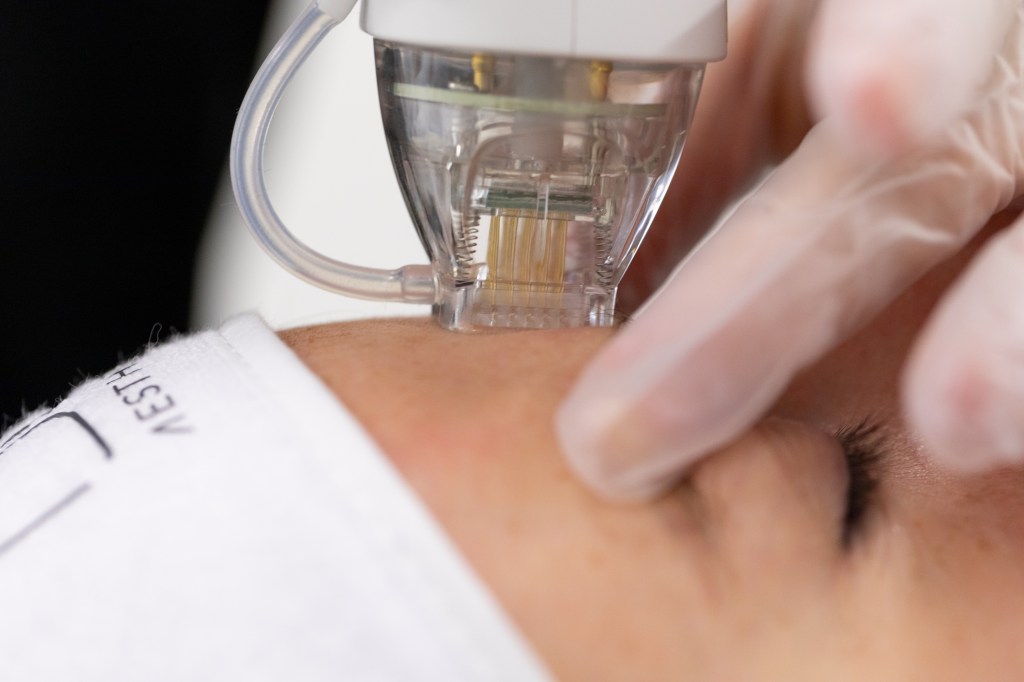
RF microneedling delivers radiofrequency energy into the skin through microneedles of varying lengths, which have been insulated, so that the RF energy emerges just at their tips.
Both radiofrequency and microneedling do very similar things, namely boosting collagen and elastin production in the skin. Radiofrequency stimulates our body’s cellular responses using heat, which helps tighten existing elastin and collagen at the same time as boosting new collagen. Microneedling creates a controlled injury, which stimulates the body’s wound healing response, once again kick-starting fibroblast activity, resulting in tightening and boosting of new and existing collagen and elastin. Microneedling’s wound healing response also helps address surface skin and textural problems such as acne scars, large pores, stretch marks and wrinkles.
Usually, the needles are insulated, except for their tips, so that the radiofrequency energy they dispense is delivered directly to the dermis, rather than dispersed into the rest of the skin that the needles are passing through.
Using needles to create micro-channels of damage enables the skin to heal itself faster than you would expect, because between each of the channels of damage is a portion of untreated, undamaged skin. So the skin isn’t trying to heal the whole of itself at once.
What does Radiofrequency Microneedling do?
By combining two already effective technologies into one, it gives a double whammy when it comes to boosting collagen and elastin and is suitable for all skin types, an additional bonus.
The radiofrequency energy, has a kind of shrink-wrapping effect on the collagen deep in the skin, so the skin will regenerate from the inside.At the same time, you’ve also got the knock-on effect of the microneedling, which is creating tiny wounds in the skin so, as those heal, you get an extra degree of collagen contraction and skin regeneration.
What does RF Microneedling treat
- Forehead wrinkles – Fine lines, frown lines, wrinkles and creasing of the skin in the forehead area
- Droopy eyes & wrinkles – Loose eyelids, creepy under eye skin, fine lines, wrinkles and crow’s feet.
- Neck Skin Tightening – Tighten and lift laxity in neck area.
- Arm Skin Tightening – The infamous bat wings can be tightened.
- Acne Scars – Scars on the cheeks or any other area of the facecaused by excessive acne and other ailments.
- Sun Damaged Skin – Marks left by excessive sun burn or dark spotscaused by repeated sun exposure.
- Uneven Skin Tone – brown tone from sun damage or acne issues.
- Stretch Marks – most body areas can be treated
- Face, Neck and Décolleté
- Abdomen
- Arms
- Legs
- Wrinkles
- Decolette wrinkles
- Loose skin
- Jawline sculpting
- Reduce eye bags
How long does radiofrequency microneedling take?
A typical radiofrequency microneedling treatment takes between 15 and 60 minutes, depending on the area being treated and the device the practitioner is using.
Before some of the more intense sorts of radiofrequency treatments, you may need to have anaesthetic cream applied to the treatment area, and to wait 20-30 minutes for the cream to take effect.
How often do you need radiofrequency microneedling treatments?
You will typically need a course of 3-4 radiofrequency microneedling treatments at regular intervals, every four to six weeks.This allows your skin to heal in between treatments. It can take three to six months to see results.
How long does radiofrequency microneedling last?
The effects of radiofrequency microneedling treatment should be long-lasting – usually up to a year – however this depends on your own baseline (the quality of your skin before treatment) and your lifestyle factors i.e. how you look after your skin post treatment and whether you drink/smoke/eat an unhealthy diet or sunbathe. A maintenance treatment is recommended between 6-12 months.
Is Radiofrequency Microneedling safe?
Yes, radiofrequency microneedling treatments are generally very safe, provided the practitioner providing the treatment is skilled and experienced with the device they are using.RF microneedling devices are using heat and needles so of course there are risks, as with many non-surgical treatments.RF has good depth control and delivers energy directly into a precise target area. It can be safely used on all skin types because it does not use light-based energy (which lasers use), so it doesn’t affect melanin in the skin.
Are there any side effects to radiofrequency microneedling?
Radiofrequency microneedling treatment can have side effects. It is using both heat and needles, so there is the potential for things to go wrong, albeit very rarely.
Side effects can include:
- Bleeding
- Redness
- Bruising
- Itching
- Herpes/cold sore breakout
- Dryness
- Pin prick marks on the skin
 Welcome to Avismo Aesthetics